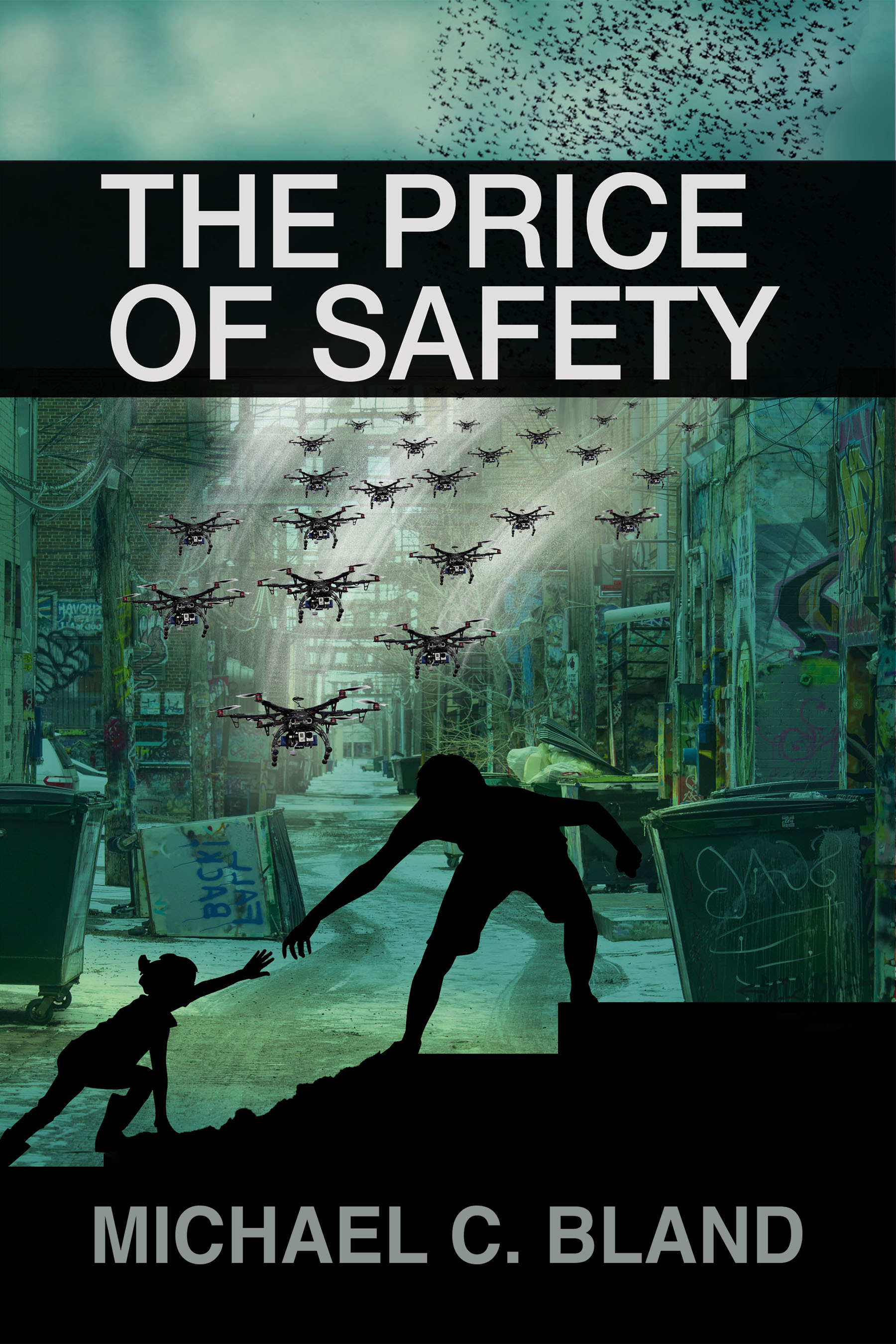
Science Fiction Thriller
Date Published: April 6, 2020
Publisher: World Castle Publishing
By 2047, no crime in the U.S. goes unsolved. No wrongdoing goes unseen.
When Dray Quintero learns his 19-year-old daughter Raven committed a heinous
act, he covers it up to save her life. This pits him against the police he’s
respected since he was a child and places him in the crosshairs of Kieran, a
ruthless federal Agent. To survive, Dray must overcome the surveillance
system he helped build and the technology implanted in the brains and eyes
of the citizens.
Forced to turn to a domestic terrorist group to protect his family, Dray
soon realizes the sheer level of control of his adversaries. Hunted and
betrayed, with time running out, will Dray choose his family or the
near-perfect society he helped create?
Excerpt
Chapter 1 from Michael C. Bland’s “The Price of Safety”
Igniting a miniature sun was the riskiest thing we’d ever attempted, yet we
were doing it in front of the entire planet.
While Nikolai bragged about our innovations to the cameras, reporters, and
two hundred VIPs assembled, I stood sixty feet away, facing the control
panel of our unlit sustained-fusion reactor, searching for any indication
our creation would explode. The seven-foot-long, concave control panel
displayed the time remaining until ignition. Forty-five seconds.
I didn’t use the control panel to conduct my search. Instead, I projected
our schematics and stress tolerance estimates onto the lenses in my eyes,
the data hovering before me like a clear computer screen stretched across my
vision. Hidden from everyone.
“...each pod contains the highest concentration of dark matter ever
collected,” said Nikolai, the CEO of our company, who’d been my friend once.
“Eighteen months’ worth of space harvesting efforts.”
We’d designed not only the pods but the entire ten-acre complex: the
energy grid, the fifty-yard-wide containment chamber where we’d try to light
the “sun” that would power our reactor, the domed observation room with
celestial images on the ceiling and a massive window that revealed the
chamber, and Nikolai’s temporary stage in front of the window. We’d also
devised the safety protocols, power regulators, and energy-capture systems.
The biggest risk was the medicine-ball-sized metal core we hoped to ignite.
A single flaw could doom everyone here.
If we succeeded, though, our reactor would provide mankind with cheap,
reliable energy—and us a spot in the history books. Nikolai would become
richer than ever, with countries begging for our reactor. I’d see my
creation come to life, which would tangibly better mankind, fulfilling a
promise I’d made.
My personal cell phone buzzed in my pocket, a number I didn’t recognize
flashing in the corner of my augmented sight. I ignored the call and
reluctantly stopped my search as the countdown neared zero. Years of
planning, of calculations and simulations and more money than I cared to
contemplate, came down to this moment.
Beside me, Amarjit, my bushy-eyebrowed director of robotics, took a deep
breath as I activated the reactor. Four titanium-geared positioning robots,
each twenty feet tall, stepped forward in unison inside the
solar-cell-lined, circular containment chamber, and lifted the dark matter
containment pods to precise spots around the core. Reinforced metal rods
moved two additional pods into position, one rod descending from the ceiling
and the other rising from the floor.
“Dark matter is the key to our efforts,” Nikolai continued, his sharp chin
pointing at the crowd. He wore his graying hair short, his thin frame coated
in a pale suit. He also wore his datarings, which was odd, as my team and I
were handling the sequence. “This unique substance causes regular matter to
draw on itself. The resulting compression, which will occur at the molecular
level throughout the core, is what we’re confident will create the fusion
spark.”
The robots locked their joints into place.
I hadn’t wanted anyone here but was outvoted by our board, my simulations
used against me. But the simulations were distorted with assumptions. I
wasn’t sure the core had the right mix of elements, wasn’t sure about the
pressure needed. Wasn’t sure about a lot of it.
I took a breath myself—aware of the lives at risk, the stakeholders and
VIPs and broadcasting cameras—and powered up the dark matter.
The robots’ hands and the two cradles glowed as they released energy into
the pods, activating the matter. Combined reverse-gravitational pressure
enveloped the core to five hundred million newtons per square meter,
squeezing it from all sides.
There was supposed to be light, the purest imaginable, maybe preceded by a
flash. But nothing happened.
Our readouts measured the core’s compression, but showed nothing that
indicated an ignition: no fusing of molecular fuels, no sign of
liquefaction.
As anxiety crawled up my spine, I increased pressure, but nothing changed
other than rising stress levels in the robots’ joints. I maxed the energy to
the pods, compressing the core to pressure levels found under the Earth’s
crust.
Amarjit shot me a look, his caterpillar-sized eyebrows squeezing
together.
I knew the danger.
The pods were made of aluminum, the only metal that could contain energized
dark matter without interfering with its reverse-gravitational force. But
the dark matter became more volatile the more we assaulted it with energy,
and the pods had limits to what they could hold.
With the forces we were manipulating, it felt like depending on a balloon
to contain a shotgun blast. If one ruptured, our entire complex would be
decimated, along with a portion of Los
Angeles. The city south and west of here should be protected from the blast
by the mountainside we’d carved into, but maybe not. The amount of
destruction would depend on the energy levels when everything went to
shit.
The readouts on my lenses flashed red. We’d reached our thresholds, yet the
core remained unchanged.
My personal cell phone buzzed again, the same unknown number.
Ignoring the call, I told Amarjit, “We’re aborting.” I touched the control
panel to kill the power to the pods, but the system didn’t respond. “What
the hell?”
I waved Nikolai over, but he wasn’t looking at me; he faced the chamber
instead, his determined expression one I’d seen countless times. His hands
hung at his sides, but his fingers were moving, entering commands. His
silver datarings flashed as he typed on his legs, the rings registering his
fingers’ movements as keystrokes—tracking where each finger moved as if he
was typing on a keyboard—and sending his commands to his neural net, which I
realized was now the only access point to the fusion reactor.
Behind him, the crowd became restless.
“Boss,” Amarjit said.
I followed his gaze. Inside the chamber, the robots extended their arms,
moving the dark matter closer to the core. First two inches. Then four. Then
six.
“I’m not doing it,” he said.
“It’s Nikolai.” I slapped at the digitally-projected controls, but they
didn’t react. “He fucking cut us off.”
WARNING flashed red in my vision as alarms sounded.
The faceplate of one of the robots buckled from the reverse-gravitational
forces emanating from its pod. The knee joint of another started to
twist.
“Dray,” Amarjit said.
“I see it.” My hands skittered across the control panel as I tried to
reboot the system but failed, my brow damp with sweat.
A strained sound reverberated inside the chamber, followed by a pop, and a
crack stretched across the curved window before us. The air surrounding the
robots shimmered like asphalt on a summer day.
I brought up the master settings to search for a power override. “Can you
take command of the robots remotely?”
“No,” he said as he jabbed at the panel. “They can only be controlled from
here.”
Robot Number Two—with the twisted knee—contorted further as the pressure
from the dark matter mounted, sparks flying from its wrists. None of our
simulations had covered this, but I knew what would happen. A few more
degrees and its joint would shatter. It’d be thrown against the wall, the
pod ripped open. We’d be obliterated in the explosion.
I needed to cut Nikolai’s signal.
The control panel rested on a bioplastic-enclosed base connected to a
hollow metal railing. The dataring receiver had to be in the base. I hadn’t
included one in the panel’s design, but it would’ve been easy for him to
add. I wondered what else the self-serving bastard had done.
“You bring any tools?” I asked Amarjit, who shook his head. “Get everyone
out of here.”
“There’s no time.”
He was right. “Then save yourself. Go.”
As he hurried away, I squatted below the panel, took my metal ID badge from
around my neck, jammed it into the cover’s seam, and tore away the
bioplastic to expose the motherboards, quantum cubes, and fiberwires that
connected to the panel. I spotted the receiver immediately, an inch-long,
fan-shaped device, and ripped it out, severing Nikolai’s connection.
I stood and hit the sequence to reestablish a link to the robots.
As systems came online, I wondered why the core hadn’t sparked. The
reaction sequence should’ve initiated, especially with so much pressure.
That’s when I noticed the liquefaction gauge. A section of tritium had
liquified but was stunted, limited to the second quadrant.
Closest to Robot Number Two.
Where the pressure was angled.
I’d approached this wrong. I’d directed pressure uniformly around the
core.
Regaining control, I linked with the robots to pull them back, but first
shifted Robot Number Three—the least-damaged one—to the right, angling the
pressure from its pod—
The core ignited.
Throughout the tritium veins that threaded the core, protons added to atoms
in a domino effect, the veins turning into contained plasma, and brilliant
light burst forth, painting the chamber. No explosion threatened us, no
pressure, unlike the destructive effect of nuclear fission. Instead, warmth
from the molten metal reached me through the glass, the chain reaction
spreading over the core’s surface to begin consuming the denser, solid
metals that would feed it for the next twenty years.
The warnings in my lenses, thrown in stark relief by the star we’d created,
turned green as I pulled the robots back to reduce the pressure to
acceptable levels, though one regarding the robots’ structural integrity
remained red.
The chamber’s window tinted, returning our vision to us.
Nikolai threw up his arms to the crowd. “As promised, nuclear fusion! The
first of many Gen Omega plants we’ll build across the country to address
America’s energy needs.”
Applause washed over us.
“Bastard,” I murmured, shaking with adrenaline.
I reduced the dark matter’s energy to the minimum amount needed to keep our
newborn sun suspended in position, while Amarjit, who’d rushed back to help,
ran diagnostics on his robots, two of which no longer stood straight.
A phone number flashed on my lenses, the same one as before. This time it
was calling my work cell. Possibly one of my employees. “Dray here.”
“Dad, I need help,” my nineteen-year-old daughter said.
I was caught off-guard, not only because it was Raven’s voice, but because
of the fear in it. I’d never heard her so afraid.
Concerned, I moved away from Amarjit. “What happened?”
“You’ve got to come.”
“Are you hurt?”
“Not me. It’s....” Someone else. Trever Hoyt, her boyfriend, who Raven had
gone out with tonight. He was a decent kid, though opinionated and a little
snobbish. I had hoped she wouldn’t get serious with him, but they’d dated
for almost a year. “Do you remember the time in
New Trabuco when I hit that rock? It’s worse than that.”
She meant there was a lot of blood. His blood, presumably. “You need to
call the po—”
“I would, except it’s me.”
I didn’t understand, then did. She’d caused the bleeding.
I started to ask if they’d been in an accident, but she was being cagey for
a reason.
Normally talkative and bright, she was avoiding saying certain words, aware
that spiders patrolled the airwaves.
Watching what she said. Trever bleeding. The way she was acting, it could
only mean one thing: she’d done something illegal, as hard as it was to
believe.
Though I was still sweating, I felt a chill. No one got away with a crime.
Not in 2047.
The people around me, the media and VIPs and shining fusion core, Nikolai
waving at me to join him on stage as he said my name and proclaimed this was
the start of “more wonders to come.” None of it mattered now.
I squeezed my finger-thin phone. “Where are you?”
“His parents’ place. Their work. There’s a spot we made where you can get
in. I’m in a small building just past a maintenance road.”
My concern increased. She meant Trever’s parents’ facility. I’d never been
there and didn’t know what they did, but I’d heard visitors required a
security clearance due to the sensitive nature of government contracts the
Hoyts had. It was a place she never should’ve been.
“On my way.”
* * *
I exited the 605 at Beverly and raced through Whittier, passing countless
neighborhoods, most of which were dark this time of night. I closed my data
streams to reduce my digital trail, and tried to avoid the surveillance that
existed even in this sleepy part of Los Angeles, the cameras and traffic
scanners and microphones that monitored most of the country. I wanted to
take side streets to further reduce my history, but needed to get to Raven.
She wasn’t the type to ask for help. Strong and resourceful, she helped
others, cared about the neglected and abused—otters, immigrants, the
homeless—and debated fiercely, but never with a mean spirit. She would
become a force as an adult—though with the way she’d sounded, I worried for
her future.
My thoughts flickered to my son Adem, who’d died before he learned to talk.
Even with how safe I’d helped make our world, I couldn’t protect him.
Couldn’t save him. I feared I wouldn’t be able to save Raven, either.
I passed the guarded entrance to Hoyt Enterprises and followed the
fortified, ten-foot-high wall for blocks until I located Trever’s
red-and-black McLaren. I tried to tamp down my fear as I parked my Chrysler
E-650 sedan beside the metal wall. I had to be level headed and calm, though
I didn’t feel either.
Spotting the hole Trever and Raven had created, two of the vertical panels
pried apart, I went to it. I’d maintained my weight over the years, but I’d
always been thick. As a result, I had to squeeze my way through the
gap.
Multi-story buildings occupied most of the compound’s interior—production,
office, warehouse—though they stood back from the wall, the structures dark,
the only light in the complex coming from the entrance far to my left.
Closer to me, one-story storage structures stretched in long rows, the
nearest five yards away. Straight ahead was an empty space followed by an
asphalt road and a cluster of residence-type buildings barely visible in the
darkness. To my right, a flat-topped building sat on top of an unlit hill
adjacent to the facility. The property was fenced, and the two parcels
shared a wall.
I started toward the residence-type buildings, sticking close to the
nearest storage structure, followed the structure to the far end, and found
a security camera staring at me. I froze, but my image had already been
captured.
My apprehension growing, I continued forward and crossed the road.
The buildings were old, possibly the property’s original development. Three
could have been homes, another a garage, a fifth some kind of lab. I
hesitated, unsure which one she might be in, heard a sound to my left, and
cautiously proceeded toward the residence in that direction.
“Raven?”
She appeared in the shadowed doorway, pulled me inside, and hugged me,
trembling.
“What are you doing here?” I asked.
“It was Trever’s idea. Dad, he attacked me. He tried to rape me.”
I stepped back. As my eyes adjusted to the darkness, I saw the swelling in
her face, her bloody lip. Her shirt was torn.
A primal rage began to grow. “Did he...?”
“No.” Her composure, thin as it was, cracked. “I didn’t mean to hurt
him.”
Her words tempered my anger and fear, though not by much. “Whatever you did
was
self-defense. You were justified. The police will see the truth.”
“I can’t.”
“They’ll listen.”
She grabbed my arm. “His implant. I ripped it out.”
His neural net, the implanted technology that linked our brains to the web,
work, and every other digital source. Federal law required that every
citizen have one, and tampering with them was punishable by death,
regardless of the circumstances. There had been complaints about the law’s
extremity, even demonstrations, but nothing had changed, and most people
didn’t care, too enamored with the access their implants granted.
My lips felt numb. “Is he alive?”
“I don’t think so.”
She led me to the next room, where Trever lay in a pool of blood, his body
contorted, his implant nearby.
I’d never seen an implant outside of a person’s head. The part that was
usually visible, the silver-dollar-sized reflective end, stuck out no more
than a quarter-inch from a person’s temple. However, the entire implant was
over an inch and a half long, with two curved leads that jutted deeper into
the brain: one about two inches long and the other about five inches.
“He grabbed me and tore at my clothes,” she said. “I tried to crawl away,
but when he grabbed me, I kicked him as hard as I could, and he rolled off.
That’s when I saw the pipe.”
She indicated a rusted drainage pipe, one end curled back where it had
broken off.
I squatted beside it, careful not to touch it. “You hit him with
this?”
She nodded.
“How many times?”
“Just once. When I swung, the pipe caught the edge of his implant. I didn’t
mean to.”
Trever wasn’t the first corpse I’d seen, but he was the first born of
violence, which made me unsettled. His right temple was caved in where his
implant had been. The metal ring that had secured his implant in place was
missing, along with a chunk of his skull. Raven’s years of playing softball
had saved her from a heinous act—but at a terrible price.
A fierce protectiveness rose inside me, joining my fear. The police would
be methodical. I had to anticipate what they’d find.
The building we were in was being renovated. The floor had been reduced to
a concrete slab and the walls gutted, with spools of wire stacked in a
corner and construction supplies strewn about. A nearby wall had blood
splattered in an arc.
Nothing contradicted her story, though doubt nagged at me. “Ripping out his
implant was a fluke,” I told her. “It was self-defense. A jury won’t convict
you."
“He didn’t rape me. I stopped him. If people could’ve seen his face, how he
lunged at me, what he said, they would understand, but there aren’t cameras
in here. No one will believe me.”
A prosecutor could claim her injuries were self-inflicted. Say she’d torn
her own clothes. Without hard evidence, she was in danger.
She didn’t have to add that Trever’s parents were politically
well-connected. Mina frequently interacted with them as chief of staff for
the mayor of Los Angeles. Jesus, Mina. She was going to be horrified.
“What do we do?” Raven asked.
“I don’t know. Who knows how many cameras I passed getting here, not to
mention the GPS in my car?”
When I left the reactor, I’d shielded my face from the cameras I knew
about, but dozens of others had probably nailed me, including the one inside
the facility. Hell, our phone call could be used against us. My work cell
had a built-in scrambler, so the cops would only get one side of our
conversation, but with the other evidence, it’d be enough.
She didn’t plead, didn’t back away. “I’ll turn myself in.”
I started for her, careful not to step on Trever’s implant, but
paused.
The implant.
If she hadn’t ripped it out, hadn’t killed him, I would’ve wanted her to
confess to the police. But if she did, she would pay the ultimate
price.
She couldn’t just leave. Not only had she been caught on camera, she was
leaving DNA: blood, hair, dead skin. I was, too.
We had to do this a different way and hope it worked, because I couldn’t
lose her. She and her sister were my world.
“I have an idea. You’re not going to like it,” I told her. “I’ve heard
rumors about people stealing implants. Cops don’t want to admit it happens,
because it’s one of the only crimes they struggle to solve.”
“Why would people steal...? Oh. To become someone else.”
I nodded. “Each has a unique code cops can use to identify us if they get a
warrant. A criminal who wants to hide from author ities can’t unless they
obtain a new code, which means a new implant—one that’s been stolen, wiped,
and recoded.”
“You want to blame Trever’s death on implant thieves.”
“To do that, I’ll have to take yours.”
Her eyes grew big. “What?”
“If yours isn’t stolen, the authorities won’t believe you.” I held out my
hands. “I’ll take it out straight, minimal damage. You can tell the police
you two were here hiding out or whatever when men jumped you. Trever tried
to defend you, but they overwhelmed him and ripped out his implant. They
were easier on you, as you didn’t fight, using the same pipe—”
“The same pipe? Dad, I don’t want to die.” She looked panicked.
I took her in my arms. “You won’t. I promise. Tell the cops the men were
masked and didn’t say anything.”
When I let go, she wiped her cheeks. “How do the police find me?”
“As soon as I take your implant, I’ll call 911.”
She paled further, eyes darting, but nodded.
I had her lay near Trever, yet far enough away that she didn’t touch his
blood.
“I’m scared,” she said.
I wasn’t a father. I was a monster for suggesting this. But I had to keep
her safe.
I touched her cheek. “I’ll make it as clean as possible. With the right
amount of force, it’ll pop out.” I had the strength. I’d manhandled the
robots we’d used in the reactor. “This is the only way.”
As she rolled onto her side, I picked up the pipe. I placed my hand on her
head, my calloused fingers nearly palming it. “I love you.”
I gently slid the hooked lip of the pipe under the edge of her implant,
wincing when the pipe touched her skin. After seeing Trever’s neural net, I
knew Raven’s had been implanted straight into her skull. If I pulled up,
like removing a nail, it’d minimize the damage. I didn’t want to do this,
and would probably never forgive myself, but it needed to look like a
criminal stole her neural net.
I had an image of her in prison garb, curled on a metal cot. Another of her
strapped to a gurney, getting a lethal injection.
I couldn’t let that happen, whatever the cost.
I held her in place with my free hand and pulled on the pipe, at first
gently and then as hard as I could. For the briefest of moments, the ring
held—she screamed—then gave way with a wet sound. The implant tumbled to the
ground as I fell back, the pipe nearly flying from my hand.
She started to shake and gasp. Sparks flickered in her eyes, and blood
welled up in the hole I’d opened in the side of her head.
A panic unlike anything I’d ever felt seized me.
What had I done?
About the Author
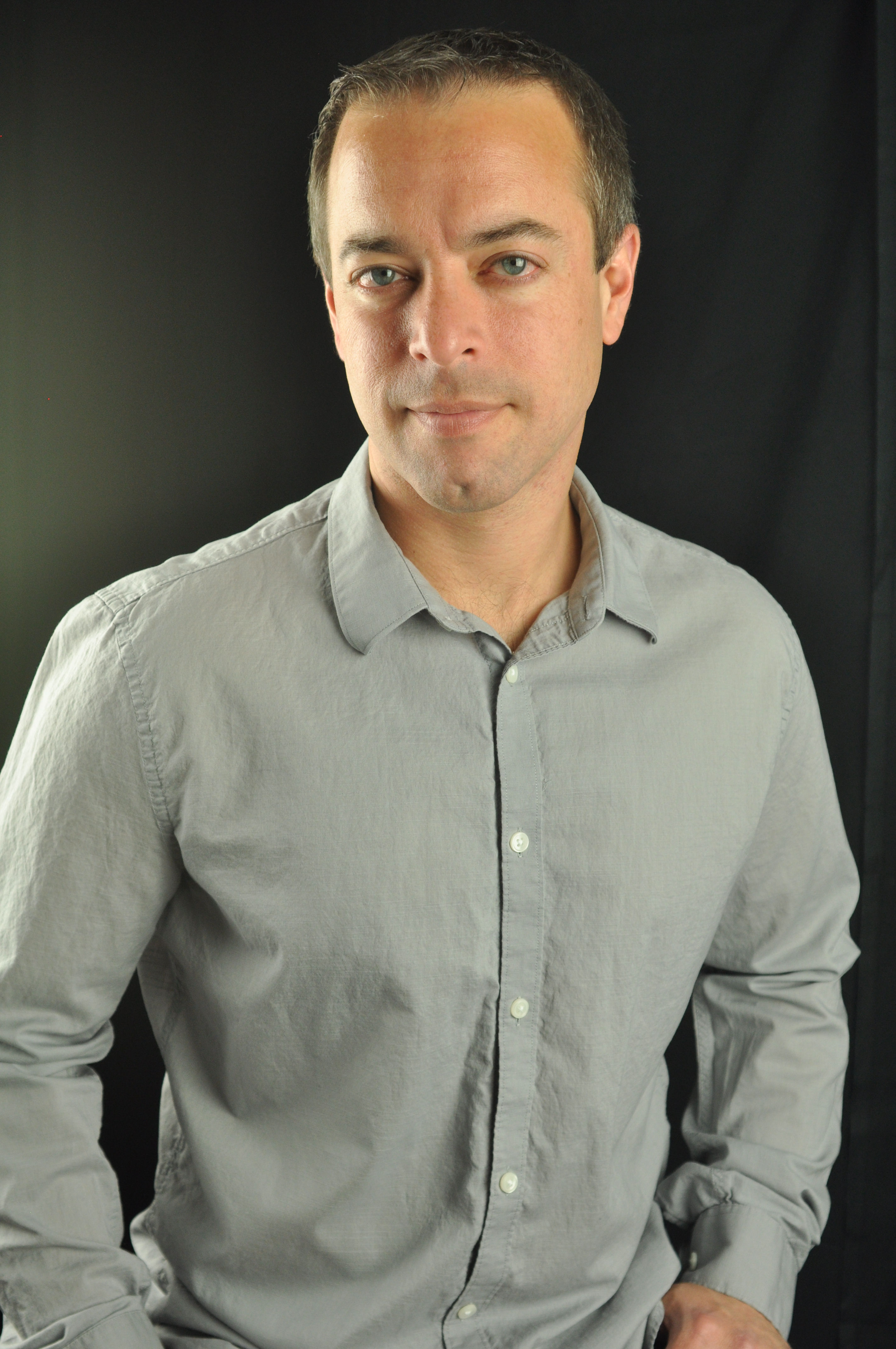
Michael C. Bland is a founding member and the secretary of BookPod: an
invitation-only, online group of professional writers. He pens the monthly
BookPod newsletter where he celebrates the success of their members, which
include award-winning writers, filmmakers, journalists, and bestselling
authors. One of Michael’s short stories, “Elizabeth,” won Honorable Mention
in the Writer’s Digest 2015 Popular Fiction Awards contest. Three short
stories he edited have been nominated for the Pushcart Prize. Another was
adapted into an award-winning film. Michael also had three superhero-themed
poems published in The Daily Palette. He currently lives in Denver with his
wife Janelle and their dog Nobu. His novel, The Price of Safety, is the
first in a planned trilogy, and has been recognized as a finalist in both
the National Indie Excellence awards and the Next Generation Indie Book
Awards. For more information about Michael’s life and work, visit
www.mcbland.com.
Contact Links
Website
Facebook
Twitter
Goodreads
Instagram
Purchase Links
Amazon
Barnes and Noble
Indiebound
Bookshop